

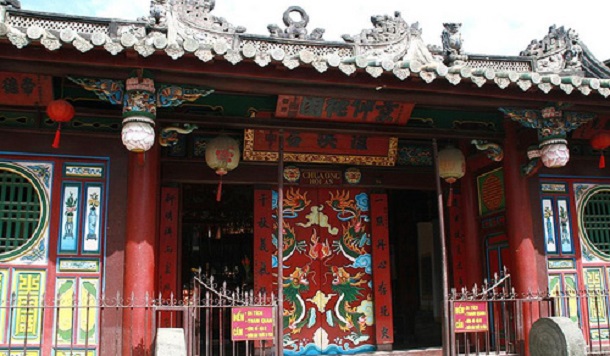
The small fishing town of Hoi An situated on the banks of the Thu Bon River, is a quiet place that affords its visitors ample scope for relaxation. The town’s other claim to fame is its many pagodas and shrines. One of them is the Ong Pagoda in Hoi An. The Ong Pagoda like most other pagodas in the region is a place engaged in not just a place of worship and meditation, but also a cultural hub, preserving the heritage of the land. The Ong Pagoda is also popularly called the Quan Cong Temple.
History and Cultural Significance
Chua Ong Pagoda, also known as the Phuc Kien Assembly Hall, was built in the early 18th century by Chinese immigrants from the Fujian province who settled in Hoi An. This pagoda serves as a spiritual and cultural center for the local Chinese-Vietnamese community, dedicated to Guan Yu (Chua Ong) — the revered God of War and Patron of Merchants.
Over centuries, Chua Ong has played a vital role in preserving the rich heritage and traditions of Hoi An’s multicultural past. It is especially significant during important festivals like Tet (Lunar New Year) and the Mid-Autumn Festival, when locals gather to honor Guan Yu through vibrant ceremonies and offerings, including the famous Cao Lau noodles, a local specialty.
The pagoda stands as a symbol of faith, community cohesion, and respect for ancestral roots, reflecting the deep historical ties between Vietnam and its Chinese settlers.
Architecture and Features
Chua Ong Pagoda is a striking example of traditional Chinese temple architecture infused with local Vietnamese elements. The pagoda’s façade is dominated by vivid red and gold colors symbolizing prosperity and luck. Elaborate dragon and phoenix motifs adorn the tiled roofs and wooden beams, showcasing expert craftsmanship.
Inside, visitors find ornately carved altars, statues of Guan Yu, and intricate lacquer work that tell stories from Chinese mythology and folklore. The main altar is flanked by incense burners and offerings tables where worshippers bring fruits, flowers, and traditional dishes.
The peaceful courtyard and decorative tiles further enhance the spiritual ambiance, making Chua Ong Pagoda not only a place of worship but also a visually captivating cultural landmark perfect for photography and cultural exploration.
Ong Pagoda in Hoi An is located at Tran Phu Street, a typically old and traditional Chinese district. The presence of this 17th century pagoda in such a location indicated towards its heritage. The temple is dedicated to Quan Cong, who was an ancient Chinese general, lived in the time of “Three Warring Kingdoms” (3nd century AD). He was a talented and virtuous general, a symbol of courage, loyalty, piety moderation and righteousness in the feudal time of China. Though restored many times, the temple’s original structure has been kept almost the same.
Notes:
Address: 168 Tran Phu street, Hoi An, Vietnam
Open daily, all year around.
Location: In the heart of Hoi An ancient town. It normally takes 15 minutes to visit it.
Entrance fee: Admission by Hoi An Day-time ticket.
Visiting Information and Tips
Chua Ong Pagoda is open daily for visitors, typically from early morning until late afternoon (around 7:00 AM to 5:00 PM). Entrance to the pagoda is usually free, but donations are welcome to help maintain this historic site.
The best time to visit is during the early morning or late afternoon when the atmosphere is peaceful, and the light is ideal for photography. Avoid peak midday hours to enjoy a quieter experience.
Located in the heart of Hoi An’s Ancient Town, Chua Ong Pagoda is easily accessible by foot or bicycle. Visitors often combine a visit here with nearby attractions such as the Japanese Covered Bridge, local markets, and riverside cafes.
When visiting, please dress respectfully and observe local customs—remove shoes before entering, speak quietly, and avoid flash photography during ceremonies.
For a richer experience, consider joining a guided cultural tour that includes the pagoda along with other historic temples and landmarks in Hoi An.
Chua Ong Pagoda plays a vital role in the cultural life of Hoi An’s Chinese-Vietnamese community, hosting vibrant festivals and traditional ceremonies throughout the year.
One of the most important events is the Lunar New Year (Tet Nguyen Dan) celebration, where locals gather to honor Guan Yu, the god of loyalty and righteousness. The pagoda becomes beautifully decorated with lanterns and flowers, accompanied by traditional music and lion dances.
The Mid-Autumn Festival is another highlight, featuring candlelit processions, offerings, and family gatherings. Visitors during these times can witness colorful rituals and sample traditional treats.
Throughout the year, regular worship ceremonies involve incense offerings, prayers for prosperity, and blessings for merchants and traders, reflecting the pagoda’s historic connection to commerce and community wellbeing.
Tourists are welcome to observe these traditions respectfully, providing a unique insight into Hoi An’s rich cultural tapestry.
- Quan Cong’s partially gilt statue, made of papier-mâché on a wooden frame, is on the central altar at the back of the sanctuary. When someone makes an offering to Quan Cong, the caretaker solemnly strikes a bronze bowl that makes a bell-like sound.
- On the left of Quan Cong is a statue of General Chau Xuong, one of his guardians, striking a tough-guy pose. On the right is the rather plump administrative mandarin Quan Binh. The left-sized white horse recalls a mount ridden by Quan Cong.
- Check out the carp-shaped rain spouts on the roof surrounding the courtyard. The carp is a symbol of patience in Chinese mythology and is popular in Hoi An.
- Shoes should be removed when mounting the platform in front of the statue of Quan Cong.
Share This Post















Welcome to Asia Travel & Leisure, your premier Southeast Asia DMC specializing in authentic B2B travel experiences across Vietnam, Laos, Cambodia, Myanmar, and Thailand.


